https://www.scrum.org/resources/blog/backlog-refinement-single-team-scrum
How DropBox Started As A Minimal Viable Product
Avoid using Blocked columns on Kanban Boards`
Radical Product Thinking
Lean and Agile are like a fast car, it helps you iterate faster, but it does not give you a clear vision and strategy.
Most companies run into Product Diceases:
- Strategic Swelling: The product tries to do too much for too many users – unfocused efforts, weak value proposition.
- Obsessive Sales Disorder (OSD): Features delivered for individual customers – fragmented product, distracted engineers.
- Narcissus Complex: Looking inwards and focusing on our own needs – disconnected from customer needs.
- Hypermetricemia: Obsession with metrics and analytics – incremental product improvement, stuck in local maxima.
And have Digital Pollution: Collateral damage from our products.
A good vision is not a short slogan or BHAG. Your vision should articulate:
- Who: Whose world are you changing?
- What: What does their world look like today?
- Why: Why does their world need to change?
- When: When will you know that you’ve arrived?
- How: How are you going to change it for them?
Product Strategy (RDCL):
- Real Pain Points – What do businesses need in the oasis?
- Design – What does our solution look like?
- Capabilities – How do we enable those capabilities?
- Logistics – How do we deliver it?
Radical Product helps you define and communicate what you are building and why.
Lean and Agile help you execute, learn and iterate under uncertainty.
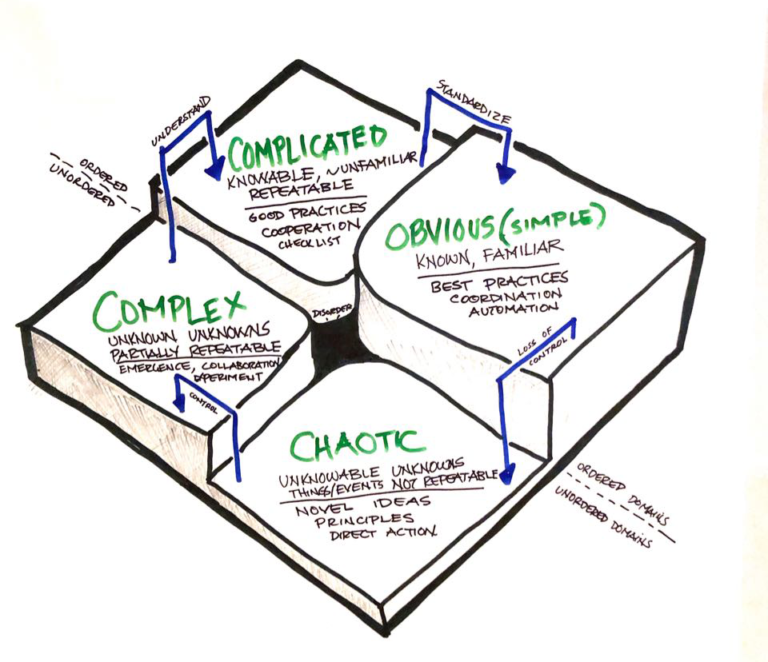
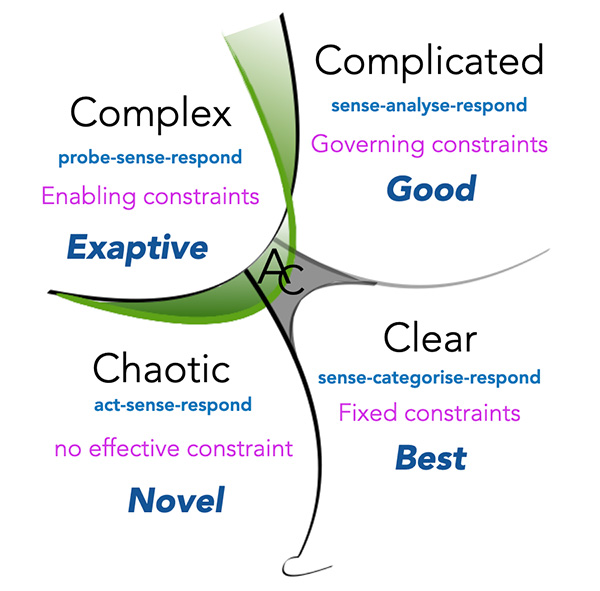
Navigating Complexity aka Cynefin for Dummies

De highlights uit Sociocratie 3.0. In het kort.
14 Success Principles of the Product Backlog Refinement
Biggest Misconceptions of Story Points and Velocity
Action Smells
Agile Bites is a new YouTube channel by agile coach Ferdinand Veldmans with bite size videos about agile concepts and tools.
Hands-on Agile 42: Lean Roadmapping and OKRs — Janna Bastow
The value is in roadmapping not in the roadmap itself
When you use roadmaps, you are making a number of assumptions:
- You assume you know how much work there is and how long each feature is going to take.
- You assume that nothing else is going to disrupt your timeline.
- You assume that each feature will work as soon as it is launched.
- You assume that each of these features actually deserves to exist!
What could possibly go wrong?
- Made up release dates
- Development due dates marches
- Mismanaged expectations
- Missed market opportunities
- Building the wrong thing
- Sad product managers
Vicious cycle: big buffers, slow work -> tighter controls, less freedom -> quality suffers, problems go unsolved -> blame culture -> repeat…
Your roadmap is a tool to help you learn and iterate at the product strategy level. In other words: Your roadmap is a prototype for your strategy.
Keep your roadmap simple!
My First Roadmap: Problem 1 -> Problem 2 -> Problem 3
Metaphor: Product is uncharted territory. Survey your surroundings, and what is at your disposal. Take one step at the time and map your journey on observations. Now -> Next -> Later.

Now: granular about your focus and scope. Stuff right in front of you
Later: less about spicific initiatives, outlining problems you think might need to be sovled to reach your vision.
The company sets top-level objectives (north star), and teams work together to decide how they can work towards this goal. Metaphor: get to Mordor: you can have my axe, bow, sword.
Objectives might be set on different levels. Some companies have more than one product, department, etc. E.g. Generic objectives, Pirate (ARRRR) objectives, etc.
Vision is essential too: FOR target customer, WHO statement of need or opportunity THE product name THAT key benefit, reason to buy UNLIKE primary competitive alternative OUR PRODUCT statement or primary differentiation.
Vision + Objectives + Time Horizons = Lean Roadmap
Objectives (what you need to achieve: improve overall health to avoid illness or injury) -> Initiatives (actions we need to take to get there: introduce regular exercise to schedule; refactor diet) -> Key results (what good looks like: lose 15 pounds by the end of the year; be able to touch toes without bending knees)
There are lots of paths forward, leave room for interpretation and creativity!
It’s not your job to have all the answers, it’s your job to ask the best questions!
(e.g. set a meal as a goal, not a steak). And don’t forget to build in room for validation. (validate what you have delivered)